

 Facebook
 X
 Pinterest
 Copy Link
Florida Amendment 3 Passed. What Changes for Tampa Bay Homeowners?
By Andrew Ricker | The Ricker Group
Updated November 6, 2026
Florida Amendment 3 will expand property-tax exemptions for qualifying homeowners starting in 2027. But the effect on your household budget will also depend on local tax rates, fees, and service decisions.
In Florida, there are approximately 4.65 million to 5.1 million full-time resident homeowners according to the Office of Economic and Demographic Research (EDR). That represents between 52.6% and 58.3% of all households in Florida. This means that more than half of all households in the state are lived in by permanent, full-time resident homeowners who claim the homestead exemption, while the remaining 41.7% to 47.4% consists of renters, seasonal residents, and vacation properties.
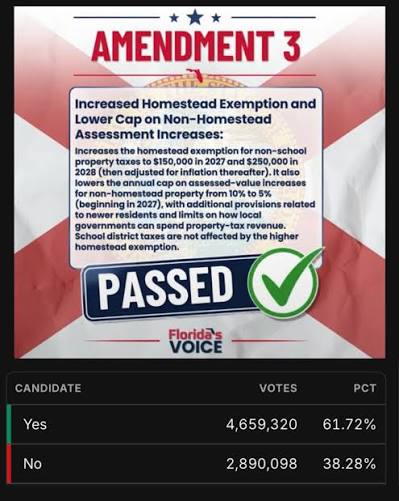
Unofficial state election results show approximately 62% approval, exceeding the 60% required. Here’s what changes—and what Tampa Bay governments are still deciding. floridaelectionwatch.gov
What does Florida Amendment 3 change?
The official amendment summary increases the homestead exemption for non-school property taxes to:
- Up to $150,000 in 2027.
- Up to $250,000 in 2028.
- Inflation adjustments afterward.
That is assessed value exempt from taxation—not a cash payment. The amendment also lowers the annual assessment-increase cap for qualifying non-homestead properties from 10% to 5%. It does not cap the total tax bill’s growth at 5%. constitutionalinitiatives.dos.fl.gov
Residency affects eligibility. Under the Florida Senate’s explanation, people establishing Florida residency after December 31, 2026, generally must reach their fifth year of homestead exemption before receiving the larger benefit, subject to the amendment’s provisions. www.flsenate.gov
What stays the same?
Your 2026 tax bill does not receive this new exemption. The changes begin January 1, 2027.
School taxes are outside the expanded exemption. Separate assessments, such as certain garbage, stormwater, and district charges, also remain. Those charges can change independently, as the Hillsborough County Tax Collector explains. www.hillstaxfl.gov
Your actual savings will depend on your property’s assessed value, eligibility, and future tax rates.
How are Tampa and St. Petersburg preparing?
Tampa: Mayor Jane Castor’s administration proposed building reserves and deferring spending ahead of the vote. City Council revised portions of that approach during budget discussions. Read about Tampa’s preparations. floridapolitics.com
At the city’s September 8 budget hearing, finance staff projected revenue reductions of approximately $35 million–$40 million in FY2028 and $60 million–$65 million in FY2029. These are estimates of lost collections, not approved department cuts. apps.tampagov.net
St. Petersburg: Officials have explored a separate fire assessment to help fund fire protection. Before the election, administrators discussed consultant work to develop the approach, rather than immediately adopting a charge. Projected revenue reductions were approximately $33 million in FY2028, growing to $54 million annually in FY2029. Read about St. Petersburg’s planning. www.wusf.org
What other options are on the table?
Nearby communities offer specific examples:
- Safety Harbor has been studying a fire assessment, with its ability to replace lost revenue still uncertain. Source
- Clearwater developed contingency plans involving staffing reductions and lower spending on libraries, recreation, and other services. These remain proposed responses, not confirmation that every cut will occur. Source
- Pinellas County already approved parking adjustments at county beach parks and boat ramps, expected to generate about $3 million annually. That decision predates the election. Source baynews9.com
Will parks, beaches, and libraries cost more?
Higher parking or recreation charges are plausible, but they are not automatic. The county’s parking changes show one approach already in use.
For libraries, the reviewed proposals point more toward funding and service reductions than charging residents for ordinary borrowing or entry. I found no confirmed blanket admission charge for Tampa or St. Petersburg parks or beaches.
Parking, boat ramps, rentals, and classes are separate from general access. Each proposed increase needs to be evaluated on its own.
As of today November 6, a final local package of Amendment 3-related fees and cuts remains unsettled.
Other Common questions
Does this eliminate property taxes?
No. It expands exemptions and changes certain assessment limits.
Are local service cuts guaranteed?
No specific closure or staffing cut happens automatically because of the amendment. Local budget decisions will determine those outcomes.
Will Florida Amendment 3 increase demand and home prices?
It could help demand by lowering ownership costs for eligible buyers. National Association of Realtors research suggests the tax relief could put home ownership within reach for more households. However, there isn’t a verified local consensus that prices will rise. Mortgage rates, available homes, insurance costs, and any new local fees will also influence what buyers can afford. More buyer interest is possible; higher prices aren’t guaranteed.
Talk with Andrew Ricker about what these changes could mean for your Tampa Bay buying or selling plans.
